Operational AI Governance for Healthcare
A structured, clinician-informed system for evaluating, approving, and monitoring AI use in clinical environments that is built into a compliance platform.
The SAFE AI Framework
The SAFE-AI Framework is not a static policy model.
It is an operational governance system designed to translate AI risk into enforceable workflows inside healthcare organizations.
Built for real-world clinical environments, SAFE-AI enables organizations to:
• Define appropriate AI use
• Assign accountability
• Manage risk and bias
• Train staff consistently
• Maintain audit-ready documentation
This framework powers the SAFE-AI compliance platform.Healthcare AI adoption is accelerating — but governance remains fragmented.
Studies show that only a minority of healthcare organizations have comprehensive AI governance structures, increasing exposure to bias, privacy risks, and unsafe workflows .
Most organizations today rely on:
• Vendor documentation
• Informal approvals
• Disconnected policies
SAFE-AI was developed to close this gap.
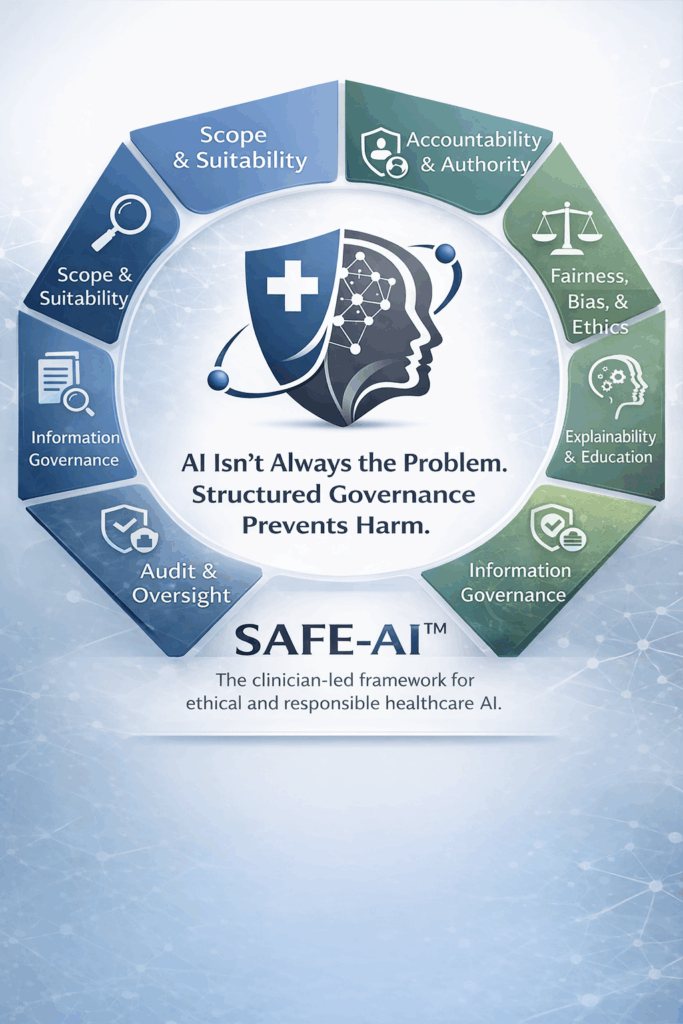
A clinician-informed framework for ethical and accountable healthcare AI.
Safe AI Pillars
S — Scope & Suitability
AI systems must be appropriate for their intended clinical or operational use. This includes clearly defining scope, limitations, patient populations affected, and whether AI is suitable for the decision it supports.
Define how and where AI is used.
• Clinical vs administrative use
• Patient population sensitivity
• Boundaries of automation
👉 Output: Structured use-case documentation tied to each AI tool
A — Accountability & Authority
Clear responsibility must exist for AI selection, use, and outcomes. SAFE-AI emphasizes defined decision-makers, clinician involvement, and organizational accountability rather than diffuse or automated authority.
Assign responsibility for AI use.
• Who approves
• Who owns
• Who oversees
👉 Output: Audit-ready approval chains and governance records
F — Fairness, Bias, & Ethics
AI systems must be evaluated for bias, equity, and ethical impact across diverse populations. SAFE-AI supports proactive identification of unintended harm and alignment with professional ethical standards.
Evaluate risk beyond functionality.
• Bias risk identification
• Ethical use validation
• Mitigation planning
👉 Output: Documented ethics review tied to each system
E — Explainability & Education
Clinicians and stakeholders should understand how AI systems function at a practical level. SAFE-AI prioritizes transparency, appropriate explainability, and education that supports informed clinical judgment.
Ensure users understand AI limitations.
• Role-based training
• Boundary clarity
• Human-in-the-loop expectations
👉 Output: Staff certification and acknowledgment tracking
A — Audit, Oversight, & Feedback
AI governance is ongoing, not one-time. SAFE-AI incorporates monitoring, auditing, and structured feedback mechanisms to identify drift, errors, and emerging risks over time.
Maintain continuous governance.
• Incident tracking
• Ongoing monitoring
• Versioned policies
👉 Output: Full audit trail and compliance dashboard
I — Information Governance & Privacy
AI systems must comply with data governance, privacy, and security expectations. SAFE-AI reinforces responsible data stewardship, access control, and protection of sensitive health information.
Control data exposure and risk.
• PHI classification
• Data handling policies
• Access control requirements
👉 Output: Documented safeguards per AI system
How SAFE-AI Becomes Actionable
The SAFE-AI Framework is embedded into a software platform that:
• Enforces required governance steps
• Generates policies automatically
• Tracks staff compliance
• Maintains audit logs by default
This ensures governance is:
Not theoretical — but operational.
Why SAFE-AI is Different
Most organizations rely on:
• Consulting reports
• Static policy documents
• Generic GRC tools
SAFE-AI is:
• Healthcare-specific
• AI-specific
• Workflow-integrated
• Continuously auditable
It transforms governance from a one-time exercise into an ongoing system.
Research and Validation
Backed by Research
- SAFE-AI Framework (Preprint, DOI: 10.2139/ssrn.6103816)
- AI Message Safety Study (Preprint, DOI: 10.2196/preprints.92475)